


|
博客详情
What is the hiccup mode in LED dimming power supplies? Does it repeatedly turn on and off?
专栏:LED Drivers Blog
发布日期:2026-08-22
Is the LED dimming power supply repeatedly turning on and off due to a fault or has it triggered hiccup mode protection?
An LED dimming power supply that shuts down shortly after startup, then restarts after a while, only to shut down again… This periodic “start–stop–restart” cycle may make you wonder: Is the LED dimming power supply faulty? Not necessarily. This cycle may indicate that the LED dimming power supply has detected an abnormal condition, such as overload or short circuit, and activated hiccup mode to prevent prolonged operation. So, what is hiccup mode in an LED dimming power supply? What triggers it? Why does the power supply repeatedly restart after activation? How does it differ from other protection modes? And how should you troubleshoot an LED dimming power supply that remains in this state?
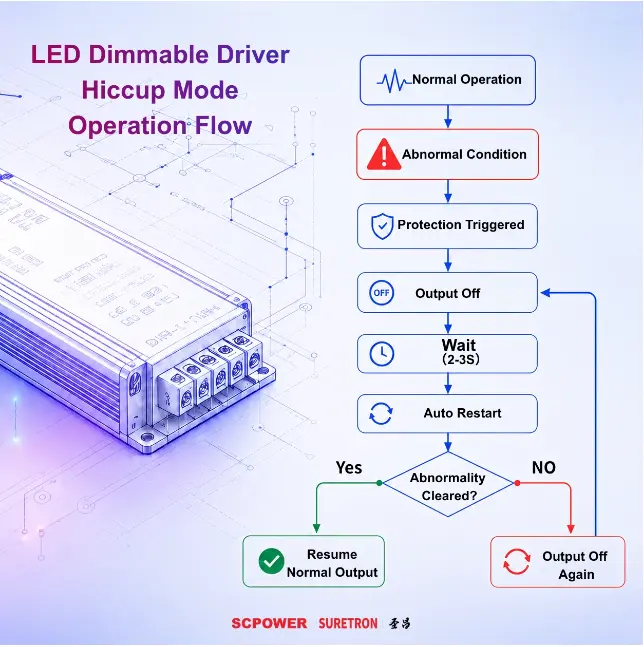
Next, let’s look at what Shengchang’s professional engineers have to say based on real-world applications. 1.What Is Hiccup Mode in an LED Dimmable Driver? Engineer Lei: Hiccup mode is an automatic protection mechanism. When an LED dimming power supply enters protection mode, it temporarily shuts off the output and automatically attempts to restart after a short interval. If the abnormal condition persists, the power supply repeatedly cycles through “output off → restart.” Once the abnormal condition is cleared, the power supply automatically resumes normal operation without manual intervention.
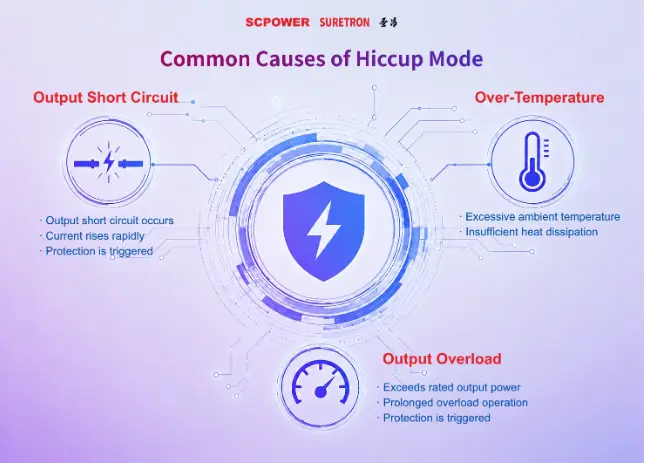
2.What Conditions Trigger Hiccup Mode in an LED Dimmable Driver? Engineer Lei: When an LED Dimmable Driver detects an abnormal operating condition, it may activate its protection mechanism. Common triggers include: -Output short circuit -Output overload -Overtemperature It is important to note that not all LED Dimmable Drivers use hiccup protection. Different products may adopt other protection strategies, such as constant-current power limiting or latch-off protection. Always refer to the product specifications for the specific protection method.
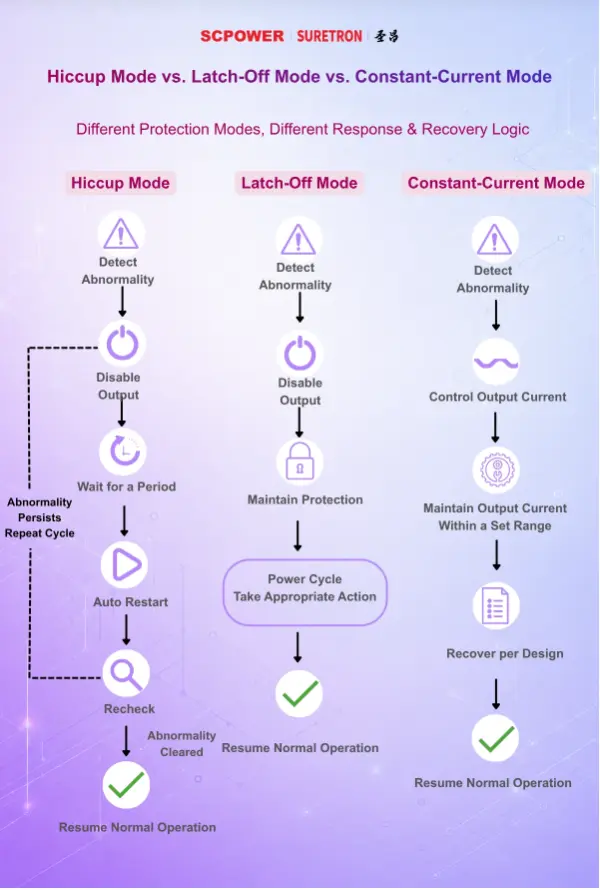
3.How Does Hiccup Mode Differ from Other Protection Methods? Engineer Lei: In addition to hiccup mode, an LED Dimmable Driver may use different protection methods depending on its design and protection strategy, such as latch-off protection and constant-current power limiting. These methods differ in how they respond to abnormal conditions and how they recover. Hiccup Mode:The driver shuts off the output when an abnormal condition is detected, waits for a period, and then automatically attempts to restart and check the condition again. If the abnormal condition persists, this cycle repeats. Once the condition is cleared, the driver can resume normal operation. Latch-Off Protection:The driver shuts off the output when an abnormal condition is detected and remains in the protection state. It typically requires power cycling or another appropriate action to resume normal operation. Constant-Current Mode: The driver regulates the output current within a certain range when an abnormal condition is detected, thereby limiting the output under abnormal conditions. The specific recovery method depends on the product's protection design.
4.How Can You Determine Which Protection Mode Has Been Triggered Based on the Symptoms? Engineer Lei: When an LED Dimmable Driver shows abnormal behavior, you can make a preliminary judgment of the protection mode based on the symptoms, then confirm it by checking the driver’s protection design, load condition, and actual operating environment.
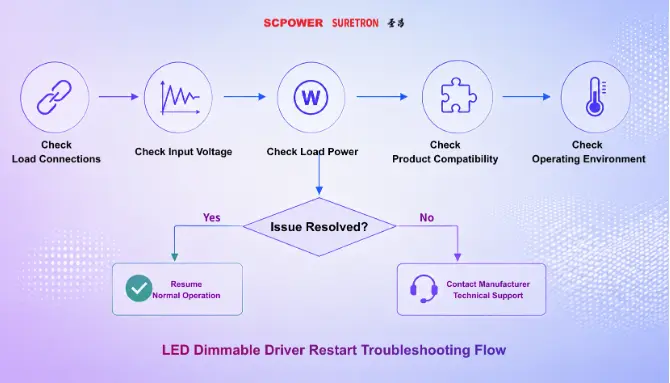
5.Does Shengchang’s LED Dimmable Driver Use Protection Methods Such as Hiccup Mode or Latch-Off Protection? Engineer Lei: Shengchang’s protection strategy is not based on one fixed protection mode for each product. Instead, the protection method is selected according to the product type, abnormal condition, and product design. For overtemperature conditions, Shengchang constant-voltage products use latch-off protection, shutting down the output to prevent continuous operation at high temperatures. Constant-current products, on the other hand, use thermal derating, reducing the output capability to control temperature rise. For abnormal conditions such as overload and short circuit, Shengchang products may use different protection methods, including hiccup mode, latch-off protection, or constant-current mode, depending on the product design. Therefore, when determining the protection behavior of an LED Dimmable Driver, it should not be assumed that all products use the same protection mode. The specific product type, abnormal condition, and product datasheet should be considered together. 6.How Should You Troubleshoot an LED Dimmable Driver That Keeps Restarting and Shutting Down? Engineer Lei: If an LED Dimmable Driver continuously cycles through “start–stop–restart,” you can troubleshoot it from the following aspects: 1.Check the load connection Confirm that the LED fixtures are connected correctly according to the product requirements. Check for short circuits, wiring errors, or other connection issues. 2.Check the input voltage Make sure the input voltage meets the LED Dimmable Driver’s specifications. Abnormal input conditions may cause the driver to enter protection mode. 3.Check the load power Confirm that the actual load does not exceed the driver’s rated output power, as an overload may trigger protection. 4.Check compatibility Check whether the LED fixtures, dimming devices, and LED Dimmable Driver are compatible, especially in dimming applications. 5.Check the operating environment Verify that the installation environment, ambient temperature, and heat dissipation meet the product requirements. Excessive temperature or insufficient heat dissipation may also trigger protection. If the LED Dimmable Driver continues to enter protection mode after these checks, contact the manufacturer’s technical support team for further troubleshooting.
For LED lighting projects, hiccup mode is just one of the protection methods used by an LED Dimmable Driver to handle abnormal conditions. To ensure stable operation of both the driver and load under different operating conditions, an LED Dimmable Driver may also incorporate protection functions such as overtemperature, overload, short-circuit, and open-circuit protection.Understanding these common protection mechanisms can help identify the causes of driver abnormalities more accurately, while also supporting better product selection and project applications. |



国内销售部:+86-756-3883779、+86-756-3890128
中山销售部:+86-756-89866406
海外销售部:+86-756-6880938、+86-756-6989859、+86-756-3866289、+86-756-6989858、+86-756-6993658、+86-756-6910178、+86-756-6910179
传真:+86-756-8596549
邮箱:info@scpower.net.cn

微信公众号
1688阿里巴巴中国站
联系我们
